Showing posts with label Bible. Show all posts

Friday, February 16, 2007

Bruce Metzger 1914-2007

If you appreciate reading the Bible that's in your home, there's a person you may never have heard of who you ought to thank.

Bruce Metzger.

Metzger, an authority on Greek manuscripts of the Bible and emeritus professor at Princeton Theological Seminary, died February 13th in Princeton, New Jersey. He was 93.

Metzger did scholarly work in determining the original words of the New Testament writers and served on the translation committee that produced the RSV and NRSV versions of the Bible. Any modern English translation of the Bible today has been influenced in one way or another by Metzger's work.

I had the privilege of meeting Dr. Metzger in 1992 when he came to Dallas Theological Seminary to deliver the W.H. Griffith Thomas lectures. It was early in the morning and he was sitting by himself in our dormitory cafeteria eating breakfast. Me and a couple of others friend asked if we could sit with him and he graciously welcomed us.

I don't remember what was discussed as much as how Dr. Metzger carried himself. When a few friends challenged him on his view of inerrancy (he believed the Scriptures were infallible, but not inerrant), his words were always gracious and kind.

Later in the week I had him sign my copy of his book, The New Testament: Its Transmission, Corruption, and Restoration. It's a fascinating book that tells the history and characteristics of the many ancient manuscripts that together give us the New Testament. The style of his signature was a reflection of his life's work--careful and precise.

Dr. Metzger was an incredible Bible scholar and a true Christian gentlemen who demonstrated how to love God with all your mind.


UPDATE: Ben Witherington's tribute illustrates Metzger's brillance and charity.

Wednesday, December 13, 2006

Matthew 1:18-25 and Isaiah 7:14 (Part 1 of 2)

If you've heard the Christmas story from Matthew 1:18-25, you know that Matthew quotes from Isaiah 7:14 in the Old Testament. For years, scholars have argued over that verse--like whether the Hebrew almah means virgin or young woman. Meanwhile, I think we've all overlooked an important aspect of Matthew's use of Isaiah.

Not only is Matthew using Isaiah 7:14 to say that Jesus is the ultimate fulfillment of what Isaiah promised long ago, he also uses it to ask you and me an important question about our relationship with God.

The question gets asked through the problem that confronts Joseph:

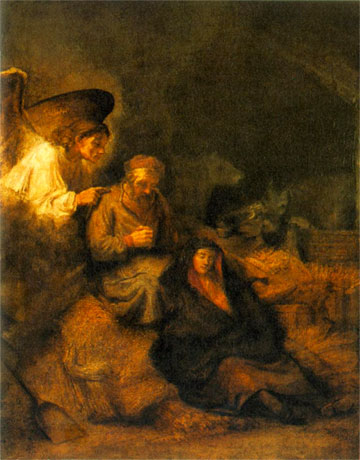
18 This is how the birth of Jesus Christ came about: His mother Mary was pledged to be married to Joseph, but before they came together, she was found to be with child through the Holy Spirit.

Joseph is bound to Mary, but before they consummate their marriage, she ends up pregnant. Assessing the situation isn't difficult. Joseph knows all about the birds and the bees. He's mad and deeply hurt. And yet...

19 Because Joseph her husband was a righteous man and did not want to expose her to public disgrace, he had in mind to divorce her quietly.

But as readers, we know something that Joseph doesn't. We've been made privy to some inside information. Mary isn't unfaithful. Rather, she's pregnant because of the Holy Spirit. So then, God is responsible for Mary's messy situation.

Makes you wonder: Why didn't God give Joseph some advanced warning--you know, an angelic "heads up" before Mary obviously looks pregnant? Why does God let Joseph find out this way?

Doesn't it make you marvel a bit about God and how He works?

On second thought, it kind of scares me!

Part 2 tomorrow.

Wednesday, December 06, 2006

In the Beginning: Media Bias Before 1000AD

Like you, I've heard complaints about how the media is biased and bent on promoting its liberal agenda, no matter the facts. We've heard those complaints for so long, it's become white noise.

But I couldn't believe it when I read this opening paragraph by Alan Cooperman in the Washington Post, an article reviewing "In the Beginning: Bibles Before the Year 1000," an ancient Bible manuscript exhibt in Washington DC:

"If 40 percent of Americans refuse to believe that humans evolved from earlier hominids, how many will accept that the book we know as the Bible evolved from earlier texts and was not handed down, in toto, by God in its present form?"

Geez, the noise of that axe grinding is deafening.

I like what Mollie at Get Religion says in response:

"See, if there is one thing I learned as a lifelong Christian, it is that the Bible was handed down in the New King James Version directly from God. And as a Christian, the foundations of my faith would be shaken if I were to be told that God did not hand down the books of the New Testament in English along with a printing press in the year A.D. 33 Every Christian knows that the canon was dictated by God Himself speaking directly to Jesus, right?

That’s why I love Cooperman’s opening graph so much. It resonates with me. I like how it ties together skepticism of human evolution with skepticism about canon development. I have never felt better understood by mainstream media than I do in Cooperman’s hands.

Sigh...

The sad thing is that Cooperman actually wrote a rather nice review of the Sackler exhibit complete with interesting historical facts and discussions with its curator. But when he went to frame the story or give it broader context, he went for the dramatic faith-shaking angle.

In so doing, he managed to cast Christians as unwitting fools who believe the Bible was delivered in Gideons form in some ahistorical manner. Was that really necessary?"

If you're not afraid to learn about the development of the Bible--yes it is inspired by God, but it has a very human history--check out this nice online feature supporting the DC exhibit, "In the Beginning: Bibles Before the Year 1000."

Tuesday, December 05, 2006

The Bible and the Story

"Ray Lewis has a story to tell, of persecution and redemption, of fathers and sons, of pain caused and pain endured. The trials he's suffered -- and Lord knows there have been many -- are all part of a master plan..."

So goes the opening paragraph of an in-depth story in Sports Illustrated on Baltimore Raven linebacker Ray Lewis in a November issue.

I was reading this article yesterday in the waiting room of my chiropractic's office.

The opening words and the picture (shown) made me think that Lewis had converted to Christianity. While I'm not sure if Jesus is his Savior (I was reading the article quickly and might have missed it), it is clear that Lewis has changed his ways since he was acquitted of serious charges in 2000.

One line in the story surprised me. It wasn't directly about Lewis, but was used to illustrate the drama of Lewis' story. It said:

"Christianity explains itself with stories."

I don't know if I've ever read such a statement in a secular work. The insight surprised me.

The SI writer is right on--that is very much the approach of Christianity (and Judiasm). If weren't for Matthew, Mark, Luke, and John (the story), we would never have Paul's discourse in Romans (the logic).

In our western culture, we typically defend positions with arguments and logic--much like the Greek philosophers of old. But in eastern culture--the world of the Bible--people make their case with a story. Theologicans identify this as "narrative theology." Out of the story, comes the lesson.

So next time you read a story and wonder what it means, or assume it's not saying anything, remember:

The story is the argument.