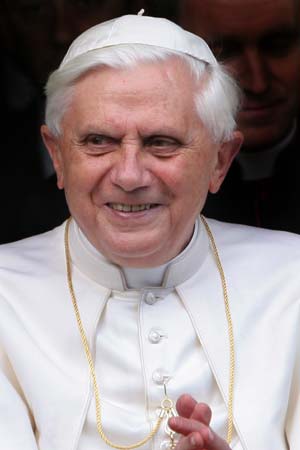
 UCC President Rev. John Thomas and Ecumenical Officer Lydia Veliko were among an ecumenical contingency of 200 Christian leaders who gathered in New York City to hear Pope Benedict XVI at an evening ecumenical prayer service on April 18.
In a press release leading up to the meeting, Thomas expressed optimism about what the Pope might say:
"As participants in many rounds of theological dialogue between Reformed Christians and Roman Catholics in the United States, we are committed to a vision of unity that can overcome the many differences that still inhibit a fully shared participation in God's mission here and throughout the world. I look forward to hearing a word of ecumenical hope from Pope Benedict that can be lived out between UCC churches and Catholic parishes around the country."While it's nice that Rev. Thomas offered polite words about going to hear to the Pope, Thomas is no fan of Benedict XVI, an opinion he made quite clear in 2005:
"Today as the conclave announces its decision, the offering of prayers for this new pontificate is the most appropriate response from other Christian leaders," the Rev. John H. Thomas, UCC general minister and president, said in a written statement to United Church News. "Nevertheless, I acknowledge that I personally greet Cardinal Ratzinger's selection with profound disappointment. Cardinal Ratzinger's long tenure in the Vatican has been marked by a theological tone that is rigid, conservative and confrontational."With this in mind, I'm sure that Rev. Thomas didn't enjoy hearing this veiled, but clear rebuke:
"Too often those who are not Christians, as they observe the splintering of Christian communities, are understandably confused about the Gospel message itself. Fundamental Christian beliefs and practices are sometimes changed within communities by so-called "prophetic actions" that are based on a hermeneutic not always consonant with the datum of Scripture and Tradition. Communities consequently give up the attempt to act as a unified body, choosing instead to function according to the idea of "local options". Somewhere in this process the need for diachronic koinonia – communion with the Church in every age – is lost, just at the time when the world is losing its bearings and needs a persuasive common witness to the saving power of the Gospel (cf. Rom 1:18-23)."Translation: That's not an endorsement of the "God Is Still Speaking" campaign.
At least Rev. Thomas went to hear someone he doesn't agree with.
But if he didn't go, what would that have said?
I'll bet the conversation over hors d’oeuvres with colleagues afterwards was interesting.







 Posts
Posts

