I'll be teaching a six hour Osher seminar on the Bible and archaeology over three Fridays October 12, 19, and 26 , on the campus of Hutchinson Community College.
Discover another dimension to God's story through the fascinating objects found over many years. This course will certainly increase your appreciation for Bible history and the reliability of God's Word.
Registration is $35 and the details are right here.
Friday, September 07, 2012
Wednesday, May 23, 2012
Simon Peter and Andrew: Lesson in Sibling Rivalry
If you grew up with brothers and sisters, you probably experienced a few tense moments of sibling rivalry. As the older brother of two sisters, I can remember incidents of fighting, but the reasons why are long forgotten. Fortunately, today I have a great relationship with both of my younger sisters.
The Bible is filled with stories of sibling rivalry--Joseph and his brothers, Jacob and Esau--but one pair of siblings rarely discussed is Simon Peter and his brother Andrew. While reading John 1:35-42, I was struck how Andrew met Jesus first, before his brother Peter, yet it's Peter, not Andrew, who becomes the star disciple in the gospels. In fact, the Anchor Yale Bible Dictionary states bluntly, "The New Testament shows little interest in Andrew." So, was there a sibling rivalry between Andrew and Peter?
We know the disciples were prone to jealousy and envy (Matthew 20:20-28; Mark 9:33-37), yet it appears that Andrew and Peter enjoyed a harmonious relationship. After Andrew encountered Jesus, John 1:41-42 tells us, "the first thing Andrew did was to find his brother Simon and tell him, 'We have found the Messiah' (that is, the Christ). And he brought him to Jesus." Notice that when Andrew had become convinced of Jesus' special nature (John 1:39), the first person Andrew wanted to tell was his brother Peter. That's brotherly love!
If you're familiar with the New Testament, you know that Peter goes on to have a prominent role in relationship to Jesus. While Andrew and Peter were both among Jesus' 12 disciples (Mark 3:16-19), Jesus did not give Andrew and Peter equal attention. Peter, along with James and John, received extra time and training (Mark 5:37; 9:2; 14:33). Interestingly, there is one incident in Mark 13:3--when Jesus discusses the end times--where Andrew seems to be butting in as he listens to Jesus along with Peter, James, and John. The last time we see Andrew's name in the Bible is in Acts 1:13. There, Andrew, Peter, and many other disciples are a unified fellowship of believers awaiting the arrival of the Holy Spirit.
Unlike the story of Jacob and Esau, the Bible doesn't tell us whether Peter or Andrew was the older brother. If I were to guess, Peter's bold personality and strong leadership style suggests someone first born. If true, then the younger brother introduced the older brother to Jesus. Peter learns from Jesus in the gospels, preaches Jesus in Acts, and writes of Jesus in 1 and 2 Peter. But in contrast to Peter's major role, Andrew is relegated to a minor character (John 6:8-9). Was Andrew envious of his older brother? Who knows? Maybe Andrew, who spent time with John the Baptist (John 1:40), took to heart one of the Baptist's lessons: "He must become greater; I must become less" (John 3:30).
Tuesday, May 22, 2012
Harvest Reading: Farm Sermons
The Kansas wheat harvest is coming early this year. Typically, harvest doesn't begin until the middle of June, but this time around, it looks like harvest will be in full swing before Memorial Weekend. Long time farmers who I've spoken with tell me this early harvest is highly unusual. In their lifetime, they can remember only one other early harvest.
Meantime, believers in Jesus are waiting for the Lord's harvest time, when He will bring to completion the end of the world as we know it. God, just so you know, it's OK with me if you want to start your harvest early!
Until then, you might enjoy this series of biblical messages, preached by the great 19th century English pastor Charles H. Spurgeon, entitled "Farm Sermons." Originally collected into book form many years ago, Spurgeon declares, "It is fit[ting] that farmers should have sermons gathered out of their own occupation, for it is one which, above all others, abounds in holy teaching." This collection has a total of 19 messages. Check one out this harvest season. Surely, it will bear some good fruit in your soul!
Tuesday, August 16, 2011
The Amusement Park Known as CCM
Denny Burk links to a funny and sad story of Meghan O’Gieblyn's experience with CCM--the contemporary Christian music scene--in the 1980's. Those years are fond memories for me because at that time I worked in a music store and hosted a Sunday radio show that played CCM.
Here's my prayer for those who relate to Meghan's story...
The Kingdom of heaven on earth is sometimes like treasure hidden in a field. When CCM found it, they hid it again, and built upon the land a corny amusement park--complete with CDs, concerts, costumes, and consumerism.
Tons of teens enjoyed the carnival atmosphere, but in-authenticity and edgier competition eventually put the park out of business.
Years later, a woman--wearied by the glitzy culture's hollow center--stopped by the abandoned amusement park. She laughed at all the old memories, but was taken aback to one particular moment when she saw an old shovel. She recalled the words of one of the carnival workers. This one spoke like he genuinely believed the message he proclaimed--"Inside this park is buried treasure!"
Taking the shovel, she began to dig. After a few moments, much to her surprise, deep in the dirt, there it was--the hidden treasure.
When she found it, she hid it again, and then in her joy went and sold all she had, and bought that field.
Sunday, March 13, 2011
Japan: Before and After Pictures
Pray for Japan as they strive to recover from their recent earthquake and tsunami. The damage is sobering, as seen in these before and after pictures.
Thursday, March 03, 2011
Grand Story of the Bible Seminar
If you or someone you know is a senior adult, I want to invite you to join me in an exploration of the Bible's Grand Story seminar that I'm going to be leading for the next three Saturdays.
Registration through Kansas University's Osher Institute is available here.
From 2:00-4:00pm, on Saturdays, March 5, 12, and 19, I'll be at Mennonite Manor in South Hutchinson sharing the Bible's entire story through my innovative 12 C's approach.
This will be the second time I've taught this seminar through the Osher Institute. I'm really looking forward to meeting new students!
Sunday, December 19, 2010
Little River Census Stats
Kansas data from the latest 2010 census is now available. Here's how my town of Little River ranks within the state:
14th in poverty--25.8%. 279th out of 286 in median household income--$27,404. I knew our community's need were great, but ranking so high out of nearly 300 towns surprised me.
263rd in median home value--$39,600. Many homes were built shortly after WW2. Today, many have severe maintenance needs. 2.6% are mobile homes. 4.7% are unoccupied (I can't imagine where they are). No homes in Little River are valued over $1 million. Kansas City suburbs Leawood and Mission Hills each have over 450.
84.4% of our citizens have graduated from high school. 9.2% graduated from college.
In 51.7% of our families, both husband and wife work. The average commute time is 22.2 miles. 37% start their commute before 7:00am. This includes our house.
13.7% of our citizens are veterans. We have a very active local American Legion.
Little River ranks #15 in single men per single women--238 single men for every 100 women.
Only .05% of people in our community speak Spanish.
Monday, November 22, 2010
Advice For When You Go Home
Here's some good advice from football coach Jim Zorn on what to do during the holidays:
“When you go home to your families today don’t walk in the room and say, ‘Here I am!’ You need to walk into the room this afternoon and say, ‘There you are.’”
Be other-centered, not self-centered.
“When you go home to your families today don’t walk in the room and say, ‘Here I am!’ You need to walk into the room this afternoon and say, ‘There you are.’”
Be other-centered, not self-centered.
Wednesday, July 21, 2010
The Secret Power of Time
Check out this fascinating talk by Professor Philip Zimbardoon on time.
Time is influenced by culture, geography, religion. And our perspective toward time affects our moods, behavior, and our brain.
What he says about the impact of technology on time is eye-opening and scary.
Tuesday, July 20, 2010
Republican First District Primary Candidates
With Jerry Moran vacating his congressional seat in order to run for the Senate, Republican voters in the Kansas first district will choose a new congressional candidate in the primary election on August 3.
In alphabetical order, here are the candidates:
Check out each of the candidate's websites and exam their take on the issues.
If fund raising is an indicator, it looks like Barnett, Huelscamp, Wasinger, and Mann have the best chance of winning.
Wednesday, June 30, 2010
Lost Dogs Perform in Oklahoma City on July 14
We live by seasons.
There's winter, spring, summer, and fall. Baseball, football, and basketball. Lent and Advent.
I have an additional season in my life. Each July, I see one of my favorite musicians, Michael Roe.
It started in the early 80's with trips to Cornerstone. When I moved to Kansas, I managed to bring Mike and his guitar to Little River for a couple of shows.
This year, he's touring with The Lost Dogs, a group of musical all-stars that deliver a versatile blend of country, roots, rock, and singer-songwriter tunes. On stage, they're personal, funny, laid-back, prophetic, charming, and stirring. Their new release is entitled, "Old Angel."
The Lost Dogs will perform in Oklahoma City, OK on Wednesday, July 14, 7:00pm, at St. Stephen's Church. Tickets are $10 in advance and $12 at the door.
Check out a sample of their music with the video above.
Monday, June 28, 2010
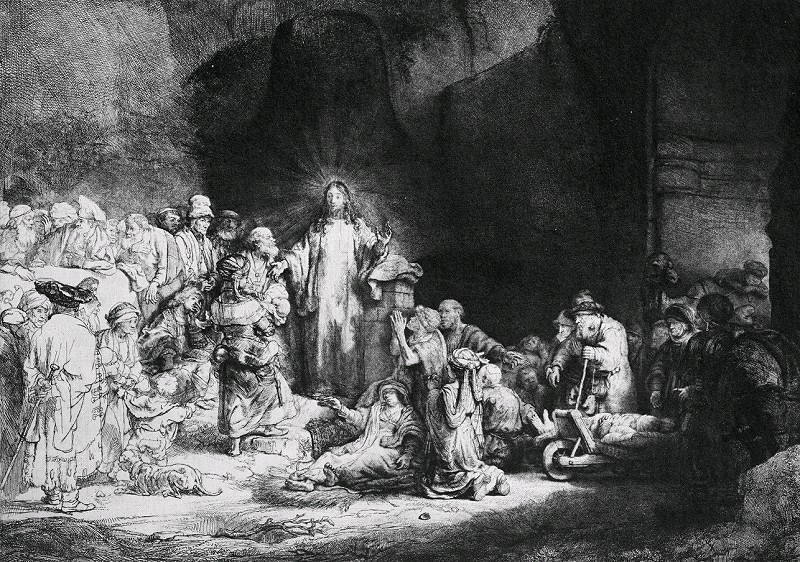
The Mystery of Rembrandt's "Hundred Guilder Print"
Biblical art has been a growing interest of mine as I've sought to visually illustrate the Bible for my college classes at Sterling College and sermons at the Congregational Church.
Rembrandt's etching, "The Hundred Guilder Print," is of particular interest. Not only does the print beautifully portray the ministry of Jesus, the story behind the etching's title has the potential of illustrating a key a Christian doctrine--redemption.
According to the Pocket Dictionary of Theological Terms, redemption expresses the theological idea that "sinful humans are 'bought back' from the bondage of sin into relationship with God through grace by the 'payment' of Jesus’ death." Redemption is one of the metaphors used by the Bible to explain God's work of salvation.
According to two websites, art scholar Christopher White traced the title's origin, "to a print seller named Mariette, who sold an impression of this print to Rembrandt himself for 100 guilders." If true, the story would be a terrific illustration of redemption. As Rembrandt bought back at great price his very own print, so Jesus at the cross paid a high price to buy back his own (Mark 10:45; 1 Corinthians 7:23).
To verify the story, I went to the library and looked up Christopher White's Rembrandt as an Etcher (Yale University Press, 2nd ed., 1999). In chapter three, White states:
The apotheosis of Rembrandt's activity in etching in the 1640's, and according to popular opinion of his whole career, is the large etching known as The Hundred Guilder Print. The origin of the title can be traced back to the story that the artist himself bought back an impression of the print for one hundred guilders.Much to my surprise, this is all White says about the origin of the print's title. No mention is made about Rembrandt buying back his print from a dealer named Mariette. Nothing is said about where this story originated. However, White footnotes his last sentence. In the book's back, footnote #56 from chapter three, it says this about the etching's famous name:
It first occurs in Conrad von Uffenbach's travel diary for 1711 (S. Slive, Rembrandt and His Critics 1630-1730 (The Hague, 1953), p. 167.When you go to Seymour Slive's book, here's what we find on pages 166-167:
De Geest's account of high prices which Dutch collectors were willing to pay for Rembrandt's work during these years is confirmed by Zacharias Conrad von Uffenbach, a German traveler, who was Holland in 1711. Uffenbach makes the earliest exant reference to Rembrandt's etching of Christ with the Sick Around Him, Receiving Little Children, as The Hundred Guilder Print in his Merkwurdige Reisen durch Niedersachsen, Holland und Engelland; he writes that he visited the cabinet of David Bremer of Amsterdam on March 1, 1711 in order to see his prints:Notice that von Uffenbach states that the print in question was sold at an auction, but he doesn't identify who it was that paid the high price.
"He has a considerable number and among the most outstanding a great number of Rembrandts; surely he had the best, but not the so-called Hundred Guilder Print, which is called thus because it once brought that high price at an auction. It represents the miracle of Christ where he heals a blind and deaf man..."
Then in footnote #1 at the bottom of page 167, Slive reports on further work he did to find out just how The Hundred Guilder Print received it's famous name. Here's what he says about his fact-finding mission:
The author has been unable to learn which collector or dealer paid 100 guilders for the etching of Christ with the Sick Around Him and at what sale this bid was made.So did Rembrandt actually pay the exorbitant price of one hundred guilders to buy back his own print of Jesus?
Unfortunately, I don't think the claim can be made with certainty. While Rembrandt was an avid art collector, it seems this particular story is more legend than fact.
I wish Christopher White said more about how the story was "traced back" to Rembrandt. In the meantime, it appears that the research of Seymour Slive is closer to the actual truth.
And those facts, ironically, are a mystery.
Thursday, June 24, 2010
Word Study Example Using Logos "Learn To" DVD
To equip Bible students to dig deeply into God's Word, Logos Bible Software recently released an innovative DVD series entitled, "Learn to Use Biblical Greek and Hebrew." Co-author Dr. Michael Heiser contends, "You are smarter than a lexicon." In other words, by knowing the steps to doing good word studies, Heiser believes you can achieve results that are as good or better than entries in a Greek or Hebrew dictionary. Apparently, lots of people are buying into Heiser's argument because this DVD set is the best selling pre-publication product in Logos' history.
So when the discs arrived in the mail, I applied the first several lessons to a word in Genesis 26:8, where it says, "When [Issac] had been there a long time, Abimelech king of the Philistines looked out of a window and saw Isaac laughing with Rebekah his wife." The translation note said that, "The Hebrew may suggest an intimate relationship." I wanted to know why, so I followed the steps given in the DVD. Below are my results. Interesting discoveries were made along the way! Bottom line, there's good justification for the translator's note.
1. Basic meaning, “to laugh.” Do we get any clue as to what kind of humor?
2. Appears in OT 13 times. 12 of 13 times are in Pentateuch. 11 occurrences are in Genesis. Then one in Exodus 32:6, and one in Judges 16:25.
3. In the story of Abraham and Sarah, where this word occurs 5 times, the laughter is one of disbelief. Because the possibility of having a child so late in life was beyond hope or expectation—especially after a lifetime of no success, the laughter revealed the comedy of the absurd.
4. Age 9 daughter driving backwards for the entire race on Mario Cart Wii illustrates the comedy of absurdity. It’s not something one normally sees or expects.
5. In Genesis 19:14, the narrator uses this word to describe the response of Lot’s family to the angel’s warning to flea the city. The thought that an entire city will be destroyed seemed absurd, that is, beyond imagination.
6. In Genesis 21:6, there’s a wordplay—Sarah testifies, “God has made LAUGHTER for me; everyone who hears will LAUGH over me.” Now, the absurd impossibility of having a child late in life has incredibly come to pass. The humor of what could never happen is now the humor of what actually occurred.
7. In Genesis 21:9, the narrator reports what appears is the laughter of mockery—that such a big deal is being made out of the fact that Isaac has stopped nursing. Who is one teasing? Is it the mother Hagar, or is it the boy Ishmael?
8. “Laughing” in Genesis 26:8—and the suggestion of interpreters that this word is suggesting an intimate relationship—is the reason for this word study. What exactly does this word mean here?
A. Was it considered culturally inappropriate for a man and woman to laugh in public? Was that considered flirting?
B. Wordplay—Isaac means “laughter.” Maybe we could translate, “...saw laughter laughing with Rebekah his wife.”
C. Context of Genesis 26:8
1. vs. 7 Rebekah is “attractive in appearance.”
2. Early on in Egypt, Isaac was concerned that is true relationship to Rebekah would be discovered. But much later (vs. 8a), in this incident, Isaac was not being careful in his public behavior toward Rebekah.
3. Imagine that you are married to your wife, but circumstances won’t allow you to have intimate relations with her—that’s frustrating!
4. After World War II, many couples kept their marriage a secret because a spouse was under 18 or didn’t want family to know.
5. Whatever behavior Isaac was exhibiting toward Rebekah, Abimelech interpreted this behavior as something that husbands and wives do (vs. 9).
6. Text of 26:8 says, “Isaac laughing with Rebekah” and not “Isaac and Rebekah laughing.” The focus is on Isaac’s behavior. Would this not be untypical in a male focused society?
D. Grammar of Genesis 26:8 (this section was authored by Vincent Setterholm in the Logos forums section) “...there is an important grammatical clue as well. In Hebrew (and English and I’d imagine most if not all human languages) some verbs generally take a direct object (e.g. I hit the ball) and some generally do not (e.g. ‘He died’, or ‘I slept’) and some verbs can occur with or without a direct object (sometimes with a change in meaning depending on which state you find them in). Verbs with a direct object we call ‘transitive’ and verbs without a direct object we call ‘intransitive’. Some verbs that are intransitive in English might be transitive in their closest Hebrew equivalent, so you can’t always reason just from the standpoint of English grammar, but in the case of ‘laugh’ and צחק, these verbs are generally intransitive. We can laugh ‘with’, ‘at’, or ‘near’ someone (that is, this verb regularly occurs with various prepositional phrases) but we don’t generally ‘laugh someone’ or ‘laugh something’. In the case of Genesis 26:8, צחק takes a direct object (Rebekah). That’s unusual and a pretty good grammatical indication that something euphemistic is going on.”
E. Tentative conclusion—context of 26:8 suggests that when Abemilech saw how Issac was acting toward Rebekah, he viewed it as behavior typical between husband and wife. Most likely, Isaac was engaging in flirtatious foreplay with Rebekah. Literal translation: “Abemilech saw laughter laughing Rebekah his wife.”
9. Genesis 39:14 and Genesis 39:17—the story where Joseph flees from the advances of Potiphar’s lying wife—provides strong evidence that SAHAQ has a sexual component in its range of meaning.
A. Genesis 39:14 there’s a parallel between “laugh” and “lie.” The NIV offers a good translation, “to make sport of us!” implying that Joseph was there for the challenge of sexual conquest.
B. At vs. 17, the verb “came” is followed by purpose statement—“came in to me to laugh at me”
10. In Exodus 32:6, SAHAQ is translated “to play” by ESV and “indulge in revelry” by NIV.
A. Their evil behavior was all encompassing, for the idolatrous Israelites “sat down” to eat and drink and then “rose up” to SAHAQ.
B. The general nature of laughter is festive and light-hearted.
C. Whether the word here has sexual connotations is possible, but not entirely clear. In ANE, idolatrous worship was often linked with sexual immorality.
11. In Judges 16:25, the captured and humiliated Samson is summoned before the lords of the Philistines, “that he may entertain us” and so Samson “SAHAQ them.”
A. The first “entertainment” word is different than the second “entertainment” word
B. Just how did Samson “entertain” them? Context doesn’t give us many clues. But in the other places where SAHAQ appears, there are sexual connotations.
12. Interesting to note—There are sexual connotations wherever the use of word SAHAQ appears. In the story of Abraham and Sarah, it concerns the inability to sexually conceive a child. In the story of Sodom & Gomorrah, the sexual immorality of the city. In the story of Issac and Rebekah, behavior indicates a husband-wife relationship. In the story of Joseph and Potiphor’s wife, it concerns adultery. In the story of the Golden Calf, immoral revelry. In the story of Samson, it’s not clear how he “entertains,” but seeing how SAHAQ is used in other places, it has to remain a possibility.
13. Initial Conclusions—SAHAQ, “to laugh”
A. Humor of absurdity. The response by Abraham and Sarah in Genesis 17-21 to God’s promise of bearing a child late in life. The promise seemed so ridiculous, so improbable, so absurd, it brought about the laughter of doubt and unbelief.
B. Euphemism for engaging in sexual behavior. SAHAQ is one of the words Potifar’s wife uses in accusing Joseph of sexual impropriety in Genesis 39.
Wednesday, May 12, 2010
Bible Books on Video
Here's an interesting video project--Bibledex--a summary of every book of the Bible.
Created by the University of Nottingham, the school's professors discuss key themes, interpretative challenges, and historical facts.
Check it out.
Created by the University of Nottingham, the school's professors discuss key themes, interpretative challenges, and historical facts.
Check it out.
Sunday, May 09, 2010
Mother's Day Song
My son's kindergarten teacher taught the entire class a song that she sang to her mother as a child, and keeps singing to this day.
The song is to the tune of Beethoven's, "Ode to Joy."
"Mother, mother, I adore thee, you have given life to me
You wash my clothes and bake me cookies, and you're beautiful to see
You make sure I do my homework, get me into bed on time,
You mean all the world to me,
I wouldn't trade you for a dime"
Here's to you Mom!
Saturday, April 24, 2010
Sorry for the Blog Fall Off
Yes, this blog has experienced a significant fall off in posts! Between church, teaching, and family responsibilities, there's been little time for social media.
Check out previous posts or links to other bloggers--who are more active than me right now.
Saturday, February 27, 2010
Links to the Intergoogle 2/26/10
CHILI EARTHQUAKE: Pictures of the 8.8 quake
HOAX: 17 best known doctored photos
HAMAS: London has become a hub for the terrorist group's fund raising efforts
TWITTER-MAZING! Twitter now generates 50 million (yes) tweets a day
TOTALLY HILARIOUS: Mouse adventure called, "Nolan's Cheddar." You must check this out! My family has watched this over and over. HT: Vitamin Z
Monday, February 22, 2010
Who Are You, Jesus?
I just made my very first video! And I'm pretty tickled about it. Take a look!
Create your own video slideshow at animoto.com.
Sunday, February 07, 2010
Tim Tebow Super Bowl Ad
Here's the Tim Tebow Super Bowl ad that will air later today.
After all the controversy and criticism from pro-abortion advocates, this ad, I hate to say, is a dud.
It says too little. It's not memorable. And it really doesn't have a strong pro-life message.
Sometimes it's said in Christian circles, "If we touch one life, it'll be worth all the effort." Given that this commercial is a missed opportunity, here's hoping at least one life gets affected.
Friday, February 05, 2010
Links to the Intergoogle 2/5/10
How Pastor Matt Chandler is taking advantage of his brain cancer diagnosis. An inspiring article of faith in the midst of suffering.
Incredible video: 3-D modeling of deep space images captured by the Hubble Telescope.
"Others May, But You Cannot." A timely reminder when you're envying what others are doing and shouldn't be doing.
Incredible video: 3-D modeling of deep space images captured by the Hubble Telescope.
"Others May, But You Cannot." A timely reminder when you're envying what others are doing and shouldn't be doing.
Subscribe to:
Posts (Atom)