Wednesday, November 01, 2006

Grieving the Loss of a Baby

Today is the birthday of Julia, our first daughter who was born ten years ago and unexpectedly died at four-days-old from severe hypoplastic left heart syndrome. The following is an article I wrote for the local newspaper soon after her death.

Thankful, Even in Loss

One morning while doing laundry, I opened a brand new box of detergent, only to find no scoop in the box. Eager to protest, I called the toll free consumer hotline and was immediately soothed with the promise of a coupon for a free box of detergent, hopefully one with a scoop in it.

This is what we've come to expect in our consumer world--a guaranteed promise when we've been inconvenienced.

I couldn't wait to show off that free box of soap to my wife. However, with coupon in hand at the grocery store, I had a rude awakening: They didn't carry my size box! I felt betrayed. I had a guaranteed coupon of comfort, but I couldn't use it.

This is how I painfully felt with God after our four day old daughter died unexpectedly. I walking down the aisle of sorrow, unable to redeem the coupons of God's love and reassurance. But this is when we especially need God's promises!

In desperation, I turned to Job, a man whose very name reminds us of suffering. Upon his own great loss he uttered, "The Lord gave the Lord has taken away; may the name of the Lord be praised" (Job 1:21).

How the Lord gave! Seeing Julia born and holding her dearly in our arms was awe-inspiring. We were so thankful to receive her.

But just as the reality of parenthood was setting in, Julia died. The Lord had taken away. The pain of losing a baby sure makes you wonder if God really is good or if God really is all powerful. Why would He allow this to happen? I don't know. I've spoken with some who've tried to make sense of their own tragedies by walking these winding, mystifying roads and I've been urged to not take the trip; it's a wasteland with no relief, only bitterness.

Not knowing where to turn, I went back to Job's peculiar declaration, "May the name of the Lord be praised" (Job 1:21b). Give thanks during sorrow? It seemed impossible, but giving thanks to God in the middle of loss brought great comfort.

I thanked God for the four heaven-filled days we had with Julia. I thanked God for the secretary at the doctor's office who gave me an appointment instead of my request to simply talk with the physician over the phone; for this reason, Julia would not die at home. I thanked God for all the prayers, hugs, and food people gave us; such an outpouring of love upheld us.

In giving thanks, I saw that whatever God brings into our lives, for whatever amount of time, it is all a gift from God.

My friend, praise over in dedication to the Lord everything you hold dear. Begin with your own life. For as Job says, we come naked into this world and leave the same way. All that we receive in-between is an unearned gift from the loving and sovereign God.

The sting of loss will still be there. However, amid the sorrow will be gratitude. Amid the pain will be comfort. And amid the tears will be hope.

Tuesday, October 31, 2006

Halloween and Christians

A couple of days ago, one of my church members asked me what our family did for Halloween at our house. Implied in the question was whether Christians should even observe a holiday that has its roots in evil and paganism.

Richard Mouw, President of Fuller Theological Seminary, gives a thoughtful response at Beliefnet.com:

"We need to be aware here of what logicians call 'the genetic fallacy'-which occurs when we assume that because something started off with a certain meaning, it still has that meaning. Many of our Christian holy days, and the practices associated with them, have pagan origins-but this does not mean that we should not have Christmas trees in our homes or celebrate Easter at a time when the ground begins to 'birth' new life."

Yet, he wisely goes on to say, Christians must be perceptive about how Halloween is celebrated today.

Children especially need to know that Jesus--through his death and resurrection--has declared victory over death and evil. While these forces are still at work, their end is certain. Why celebrate forces whose power is limited and will be ultimately done away with?

My three young kids are all excited about trolling for candy. That's all Halloween is to them.

Mom is worried about all the sugar they'll ingest.

That's the greatest Halloween evil we're worried about.

Monday, October 30, 2006

God Is Still Speaking Seminar

This past weekend my family and I enjoyed the fall colors of the Missouri Ozarks at the Windermere Conference Center.

I led a two day seminar on the United Church of Christ's "God is Still Speaking" identity and advertising campaign for the Missouri chapter of the Biblical Witness Fellowship. The five sessions were based on a paper I originally presented at Faithful & Welcoming Churches national gathering this past August.

According to the New York Times, the UCC this coming Advent will spend $50,000 on blog and Internet advertising--using the Still Speaking commercials to promote the denomination.

While the Still Speaking commericals--and the theology behind it--has plenty of flaws, they still have much to teach us about what it means to be the church and help people grow in the holiness and grace of Jesus Christ.

Thursday, October 26, 2006

Stay or Go? Ground Rules to be Proposed

Last night our church held its quarterly meeting. The two-hour meeting included committee and group reports, election of officers, approval of next year's budget, and further discussion about our relationship with the United Church of Christ (UCC).

A committee was appointed to propose "ground rules" for deciding whether or not to remain in the denomination. The rules will be presented as an amendment to the church's constitution (currently, it has no guidelines). If the church votes to amend the constitution, a meeting will then be scheduled between January-March for the purpose of discussing our affiliation; at that time, a motion could be made to schedule a vote.

The tone of the discussion was vigorous and respectful. I was encouraged by the church's desire to handle this in an orderly fashion, deciding to establish first the rules for any decision. I was also encouraged that a step was taken toward resolving this matter. People want to see a decision get made and settle the issue--one way or another.

In my pastor's report, I shared what I think is the bottom line question: Can we, as an autonomous local church, in good conscience be in covenant with others who hold beliefs that are sometimes or frequently different than our own?

I told the church this last year--and said it again last night: I believe sufficient warrant exists for withdrawing from the UCC. Synod’s decree for same-gender marriage was a significant, egregious departure from the clear teachings of Scripture. But in staying or leaving, I believe Scripture gives us a choice. We can be faithful to God in staying put. We can also be faithful to God in departing.

In staying put, there is this biblical testimony: In the Old Testament, the prophets remained within a disobedient Israel—working to reform it and also comforting the remnant. When Elijah told God he felt alone in calling for righteousness, he was reminded of 7,000 other faithful prophets (1 Kings 19). In the New Testament book of Acts, the followers of the resurrected Jesus preached in the Temple at Jerusalem—their spiritual home and heritage—up until the moment they were kicked out by the Jewish authorities. Only then did they leave.

In leaving, there is this witness: The Apostle Paul told the Corinthians to separate themselves from anyone who calls him or herself a believer and yet is regularly involved in immorality (1 Corinthians 5:1-13). Throughout the New Testament, the church is called to uphold standards of holiness—doing so in the spirit of grace and forgiveness (Galatians 5-6; Ephesians 4-5; 1 Thessalonians 4; 1 Peter 2). And there are frequent warnings against false teachers and doctrines (Galatians 1; Colossians 2:8; 1 John 4:1-6; Jude). We are not obligated to leave, but we are free to do so if we sense that this is God’s will.

The challenge before us is admittedly difficult. But this is the situation God has sovereignly put before us. For this reason, I believe that as we rely upon Him, He will help us.

Certainly, whatever we decide will significantly impact our future.

We are approaching a milestone in the church’s life.

Wednesday, October 25, 2006

Prayers and English Composition

Every night, me and my three-year-old son David have a little nightly ritual.

We walk the dog together.

For ten minutes, we have time to ourselves and talk about whatever. Often we look up in the sky and find the moon or point out stars.

Our route is around the block. David usually walks about half way. Eventually he gets tired and says to me,

"I want to hold you."

That's what he says, but the grammarian in me says he actually means, "I want you to hold me."

But the last time this all transpired, it dawned on me that maybe David's language skills are just fine.

Instead of issuing a command or request ("I want you to hold me"), what David really wants to communicate is the desire of his heart ("I want to hold you").

A lot of times when I pray, I tell God what I want Him to do for me ("I want you to...").

But next time, I'll learn from my three-year-old, and just tell God, "I want to hold you."

Tuesday, October 24, 2006

Sister Rivalry

Today my eight-year-old daughter Jenna went off with Grandma on a trip for a couple of days .

Right before the two left, my five-year-old daughter Valerie said, "Bye Jenna." (very sad)

But when Valerie got inside the house, she told her mother, "Jenna's gone!" (very happy)

Monday, October 23, 2006

The Definition of Blogging


I found this definition of blogging on the mast head of Guy Kawasaki, who happens to have a very good blog at Signal Without Noise:

"Blogger, n: Someone with nothing to say, writing for someone with nothing to do."

Hmmm, reminds me of someone...

Friday, October 20, 2006

The Famous Leader I Am Like

Next week is our church's annual meeting. One of the items to be discussed is our relationship with the United Church of Christ. Do we stay in the denomination or do we leave? The question arose when the UCC's General Synod 25 in July, 2005 endorsed same sex marriage.

The 15 month long conflict has not been pleasant and has tested my leadership skills like nothing else. I've lost a lot of sleep--worrying and wondering how to properly handle the crisis.

So when I found the SimilarMinds test at Philosophy Over Coffee that would compare my leadership style and ability to handle conflict to a world famous leader, I was eager for some self-discovery and insight.

So I took the test. And I had to laugh when I saw the results. Scroll down to see.


Thursday, October 19, 2006

We Remember

I've read the following quote before, but never with the final note.

From Kem Meyer:

We remember...

10% of what we read,
20% of what we hear,
30% of what we see,
40% of what we do
and
100% of what we feel.

--Dr. Karl Pribram

Wednesday, October 18, 2006

Persistence Pays Off

Hearing on Saturday night Gwen Clark's story of perseverance was interesting to me because in a few short hours, after I got home from the K-State football, I was going to preach on the Canaanite woman in Matthew 15:21-28 who persists in asking Jesus for her daughter's healing.

I asked Gwen, "What motivated you to work so hard?" She said, "I'd never won anything before."

Later on I thought, "Golly, and past experience suggests you won't win anything now!"

But that didn't stop Gwen. She kept her eye on the prize.

In a similar vein, the Canaanite woman persisted in asking Jesus. She displayed a dogged faith--even when God appeared aloof.

Frederick Dale Bruner writes, "Faith believes Jesus is good--even when reason isn't so sure."

Persistence pays off--in the spiritual and secular realm.

Tuesday, October 17, 2006

Clark Wins Alltel Contest at Kansas State

Yesterday I shared about sitting in a 3rd floor suite at Bill Snyder Family Stadium to watch the Kansas State-Nebraska football game this past Saturday.

It was great fun. I felt like a mouse that sneaked into a castle. You know the old saying: It's not what you know; it's who you know. While that adage applied to me, inside the castle I met another mouse--Gwen Clark--who literally won her way inside the Alltel suite.

Clark, a K-State junior from McPherson, Kansas, won an Alltel contest--not with mere luck, but persistence.

First, she wrote a 50-word essay explaining why she should win a football party for herself and 100 of her friends. Her essay got selected along with 9 others as finalists. Then, she had to solicit friends and family to vote for her, either by text message or online.

And what did she win? 100 tickets to the K-State-Nebraska game. T-shirts for all those friends. A tailgate party for all those friends. 10 tickets in the Alltel "castle." A 42" plasma TV. A mountain bike. An autographed Ron Prince football. $1,000 cash. A MP3 player. And before the game started, a live picture of her and all her friends was shown on the stadium jumbotron.

Pretty good, huh?

Curiosity getting the best of me, I asked Clark, "How did you get so many people to vote for you?" She said, "I basically quit being a college student for a week and begged anyone and everyone to vote for me."

So why was she so motivated? She told me, "I've never won anything in my life and I decided that I wanted to win something...I voted for myself 2,000 times. My mom voted for me 2,000 times. And other friends and family voted for me 9,000 times."

All together, Clark garnered 13,000 votes and won by over 4,000.

After hearing all that, I thought, "Wow."

Then, the late -Saturday -night -and -won't -get -home -till -after -1:00am -preacher -who -still -hasn't -finished -his -sermon -for -Sunday -morning, thought:

"Bingo, she's my sermon illustration for tomorrow!"

More about that next time.

Monday, October 16, 2006

Suite Football Game

Saturday night was quite a treat as my Kansas VP of Alltel sister-in-law invited me to attend the Kansas State-Nebraska game in a 3rd floor Alltel suite at Bill Synder Family Stadium.

K-State lost to Nebraska, 21-3.

The suite was literally and figuratively rarified air. I've never had the privilege of watching a football game in such an awesome environment. Comfortable digs and lots of free food and drinks. The experience was like driving a Porsche after years behind the wheel of a Honda Civic. Once you taste luxury, suddenly normal doesn't look quite as good anymore.

If another suite ticket were available in the future, I could make the sacrifice of time to be available!

Friday, October 13, 2006

October Snow


It's October, but Chicago, Detroit, and Buffalo already have snow. Parts of the Great Lakes and Midwest had up to 2 feet of snow.

So much for global warming.

Thursday, October 12, 2006

What If the Amish Were In Charge of War on Terrorism?

Diane Butler Bass, writing at God's Politics--a new blog featuring Jim Wallis and other Christian progressives--raises an intriguing question: What if the Amish were in charge of the war on terrorism?

Sparked by her admiration of the Amish people in Nickle Mines, PA and how they've responded to the school shooting atrocity, Bass confesses:

"Despite attempts to avoid this particular news, the stories of the Amish practice of forgiveness eventually captivated me. Their practice of forgiveness unfolded in four public acts over the course of a week. First, some elders visited Marie Roberts, the wife of the murderer, to offer forgiveness. Then, the families of the slain girls invited the widow to their own children’s funerals. Next, they requested that all relief monies intended for Amish families be shared with Roberts and her children. And, finally, in an astonishing act of reconciliation, more than 30 members of the Amish community attended the funeral of the killer. "

After a conversation with her husband, she wondered aloud:

"What if the Amish were in charge of the war on terror?"

That's an incredible question! By "incredible," I mean good, imaginative thinking.

Bass ponders the possibilities and then concludes:

"So, here’s my modest proposal. We’re five years too late for an Amish response to 9/11. But maybe we should ask them to take over the Department of Homeland Security. After all, actively practicing forgiveness and making peace are the only real alternatives to perpetual fear and a multi-generational global religious war."

I'm not sure I agree with Bass' suggestions.

But she sure has me thinking. I appreciate her creative thinking and Christian witness.

Wednesday, October 11, 2006

Reginald Betts Makes a New Life for Himself

He was smart and talented, yet landed in jail after making a bad choice. Now, Reginald Betts is encouraging youth to learn from his experience as he makes a new life for himself.

Betts' story, told by Lonna O'Neal Parker in the Washington Post and printed Monday in the Hutchinson News, is inspirational and telling.

Betts was a smart kid growing up, but didn't apply his wisdom to his personal life.

"I had a teacher who honestly, legitimately didn't like me," Betts says. "But I legitimately, honestly was not a likable person."

When one of Betts' school teachers figured out that making him read kept him quiet, Betts discovered that he enjoyed reading. Even though he showed academic talent in high school, Betts did barely enough to get by and smoked dope with friends after school.

Betts had never been in trouble with police, but he says, "I wasn't fully law-abiding either." In December of his junior year of high school, Betts and a friend drove a stolen car to a mall. There, they found a man asleep in his car. Betts pointed a borrowed pistol at the man, stole his wallet, and drove off with his car. After they tried to buy $300 worth of clothes with the heisted credit card, Betts got arrested. Tried at 16 as an adult, Betts was found guilty and sentenced to 8 years in jail.

Why did he do it? "Basically," Betts says, "I did it because I wanted to and because I could and because I didn't think it would define me for the rest of my life."

While prison hardens most people, it changed Betts. When he got out, he determined to live a different life.

Nearly a year after he got out of prison, Betts, 25, started the YoungMenRead book club at Karibu Books in Bowie, Maryland.

"Young people don't read because they don't see other people they can associate with being cool reading," Betts says. "I've got a space where we can come together."

A straight 'A' student in junior college, Betts is focusing on keeping his grades up and figuring out where next to attend school.

Here's hoping that many will read and learn from Betts' life.

Tuesday, October 10, 2006

Ron Prince's Coaching Move for Josh Freeman

"Why did you move offensive coordinator James Franklin from the field to the upstairs coach's box?"

That was one of the questions asked by Wyatt Thompson to Kansas State's first year Head Football Coach Ron Prince on his radio program last night, after K-State beat Oklahoma State over the weekend.

Prince explained that the move was done to benefit their first time starting quarterback, freshman Josh Freeman:

"I moved James upstairs into the booth so whenever Josh came off the field, he immediately had to put on his headset and listen to his coach.

A young quarterback, especially one starting for the first time, gets a lot of people coming over to him and talking in his ear. Some players want to encourage him, some want to point out something, some want to do a little politicking for the ball.

But if Josh has that headset in his ears, he can't listen to any of that. So I told James to talk to Josh the entire time the offense is on the sidelines."

That was a fascinating answer. That's a coach who is thinking about everything.

After hearing it, I thought, "There's a real spiritual principle there too."

As Christians, sometimes you must cut yourself off from all the well-meaning voices and just listen to your Heavenly Father.

Folks want to give you advice. Friends want to boost you up. Others want you to do them a favor. Everybody has something "good" to tell you. Lots of messages.

But sometimes, the best thing to do is get away from all the well-meaning voices, go to a quiet place of solitude, and listen solely for the voice of God.

Putting on the spiritual headset.

Monday, October 09, 2006

Baby Dedication Ceremony

Pastors, are you looking for a baby dedication ceremony?

Here's one that I wrote some time ago and is posted at bible.org.

When the site was redesigned over a year ago, it became difficult to find.

Hope it helps your ministry.

Friday, October 06, 2006

Summary Thoughts about the UCC KS-OK Annual Meeting

As I was thinking about how best to summarize last weekend's annual meeting of the UCC Kansas-Oklahoma Conference and the response to our resolution, "After Dialogue, a Declaration about Marriage," I was reminded of a poignant saying and story from G.K. Chesterton (1874-1936) told by Dale Ahlquist in his book, "G.K. Chesterton: The Apostle of Common Sense." He writes:

"In 1905, a famous London newspaper, the Illustrated London News, hired Chesterton to write a weekly column. He was told he could write about anything he wanted--except religion and politics. Chesterton responded by saying there was nothing else worth writing about...

Chesterton went ahead and wrote the column for the next 30 years, and every week he wrote about religion and politics. He never backed away from controversy, but if you think about it, every controversy, every argument, every discussion is really about religion and politics. Or both. Religion has to do with our relationship with God. Politics has to do with our relationship with our neighbor. These are controversial for the simple reason that all the problems in the world come from our failure to obey the two greatest commandments: to love God and to love our neighbor.

As Chesterton says: "The Bible tells us to love our neighbors, and also to love our enemies; probably because they are are generally the same people."

Thursday, October 05, 2006

Question

Here is a question posed to me by a delegate at the annual meeting of the UCC Kansas-Oklahoma Conference:

"What does welcoming homosexuals into our denomination have to do with changing the definition of marriage?"

Any takers?

Wednesday, October 04, 2006

Creating More Room for Dialogue

In the previous post below, I described what my church did and didn't do in the yearlong dialogue on marriage among churches in the UCC Kansas-Oklahoma Conference. Today, I'll share one step that the UCC and its conferences might consider to promote dialogue.

On Friday afternoon at the KS-OK conference annual meeting, I had a pleasant lunch with 77- year-old Bob Lemon, a practicing attorney and delegate from Mayflower Church in Oklahoma City. He told me this story:

"Years ago in Texas our church was approached by PFLAG. They asked if they could hold their meetings at our church. The vote was 35-1. I was the only one who voted in favor."

I asked Bob, "Do you have any suggestions on how someone in the minority, like myself at this conference, should handle himself?"

When you're in the minority, you obviously don't have the power of the majority. Yet, the majority--especially in the church--has some obligations to the minority, even as it exercises its majority privileges.

When lunch was over, Bob asked, "There's a movie showing tonight at 10:00pm called Inlaws and Outlaws. I've seen it twice. It's very good. Would you see it with me?"

I thought to myself, "Golly, when a 77 year old gentlemen asks you to stay up late to watch a movie, what's your excuse?"

I told Bob, "I'll be there, but you buy the popcorn."

I watched the movie--it persuasively advocated Bob's position that marriage can and should have a broad definition (not necessarily one man-one woman)--to reflect our diverse culture.

Afterwards I thought, "What is here at this conference that I can invite Bob to--that would reflect my view of marriage?"

Other than our resolution, there wasn't anything.

When I attended the conference sponsored marriage dialogue training back in January, the only material recommended for discussing the meaning of marriage was the UCC produced "God is Still Speaking about Marriage." That material advocates only one position--and it isn't the traditional definition of marriage.

But isn't that intellectually dishonest? To offer only one side of the story and not the other? Especially on an issue so difficult and dividing as same gender marriage?

Here's another example. This weekend our delegates debated and voted on a living wage resolution. It advocates the conference and its churches pay its employees not the state's minimum wage, but a "living wage" of $9.60 an hour.

On the meeting schedule was a "pro" living wage presentation. On top of that, the presenter was former UCC President Paul Sherry. Nothing was scheduled for the other side--even though legitimate concerns surfaced during the formal debate.

I realize it puts conference organizers in an awkward position to have a seminar that opposes what a former UCC president advocates, but isn't presenting a fair debate the UCC way? To provide dialogue from all sides, before a decision is made? When the annual meeting has on its schedule a seminar for only one of the points of view, isn't the outcome of the vote already decided?

When the UCC debates hotplate issues in the future--nationally and conference wide--it'd be wise to provide an equal platform to both sides--so each can layout their case.

Bob, I know what it's like to be the 1.

Tuesday, October 03, 2006

Dialogue and the Marriage Resolution

"Where was the dialogue?"

That was one of the main questions asked about our church's resolution, "After Dialogue, A Declaration About Marriage," by delegates at the annual meeting of UCC Kansas-Oklahoma Conference, which concluded this past weekend.

Our church made some efforts.

I attended the daylong marriage dialogue training sponsored by the Conference in January. Facilitator Rev. Mike Schuenemeyer did an excellent job showing the 12 who attended how to create and maintain a safe discussion environment.

Our church sent a letter to all 80 churches in the conference, inviting them to receive a free package of marriage resources. The material featured 3 books and a DVD interview with Dr. Robert Gagnon of Pittsburgh Theological Seminary. 5 churches responded to our offer.

Could our church have done more? Sure.

I was disappointed that our church declined an offer for a dialogue exchange with an ONA church in Oklahoma. While it might not have changed anyone's convictions about the definition of marriage, it would have put a human face on the discussion and lowered the rhetoric on both sides.

But as one lady said Saturday when the resolution was being debated, if 80% of the 2005 annual meeting delegates voted for a dialogue, it was incumbent on them to carry it out. It wasn't just Little River's responsibility.

What else could have been done? Some suggestions next time.

Monday, October 02, 2006

Marriage Resolution Voted Down

Delegates this past weekend at the annual meeting of the UCC Kansas-Oklahoma Conference voted down our church's resolution defining marriage as one man and one woman.

The vote to adopt was 24 yes (17%), 96 no (66%), and 25 abstentions (17%).

An earlier amendment to postpone the resolution was defeated--69 no (54%) to 59 yes (46%).

Bruce Ramage, our church's deacon and resolution representative, thanked the delegates for allowing our resolution to be voted upon. It was a grace note that capped off a weekend of difficult discussion.

I expected to take home the message that our resolution was voted down.

But I'm also bringing back word that we are loved.

That was a pleasant surprise and it puts all the discussion in better perspective.

Our church still has decisions to make on whether or not to stay in the United Church of Christ.

To that end, I covet your prayers.

Friday, September 29, 2006

Acoustic Version of Vertical Horizon's "Everything You Want"


I'm an admitted latecomer to Vertical Horizon, Matt Scannell, and this song, "Everything You Want."

Apparently, the tune was a huge hit in 2000. I swear, I don't remember it. I'm really out of the loop since heading off to Dallas Seminary and departing School Kids Records in Athens, Ohio in 1990.

At any rate, this song is awesome! I first heard it at the Taylor Guitars' website. Here it is courtesy of YouTube. Incidentally, did you hear what Mark Cuban, owner of the Dallas Mavericks and Internet sleuth, said to businessmen about YouTube?

After listening to the studio version on the radio the other day, I definitely prefer the acoustic version.

Enjoy.

Thursday, September 28, 2006

Oprah and Kristin Armstrong on Marriage

Recently, TV talk show host Oprah interviewed Kristin Armstrong, former wife of champion cyclist Lance Armstrong, on "The Truth About Marriage." In the hour-long show, Armstrong warns against marriage's ability to erode your self-identity.

In a Glamour magazine article, Armstrong declares:

"Here is the truth as I see it: Marriage has the potential to erode the very fiber of your identity. If you aren't careful, it can tempt you to become a 'yes woman' for the sake of salvaging your romantic dream. It can lure you into a pattern of pleasing that will turn you into someone you'll hardly recognize and probably won't like. I am warning you because I only wish someone had warned me...If I were to do things over again, I wouldn't have thrown myself so irrevocably into my new life. I would have guarded the things that made me feel like me."

I didn't see the show, but Suzanne Venker did. She gives an insightful response to Armstrong's interview and magazine article. The problem isn't marriage; rather, she says, it's our view of it:

"No doubt her heart is in the right place, and she has at least recognized that something is amiss in modern marriage. Unfortunately, her revelation isn’t revelatory. Today’s wives are not losing their identities in droves. [Feminist Betty] Friedan hit that nerve some forty years ago, and the drum has been beaten to death; it is a danger that women today are quite alert to.

The real conspiracy — though I don’t believe the neglect is sinister, and thus perhaps “conspiracy” isn’t the word — is the silence about how hard marriage is. Not only does being married involve sacrifice that is sometimes overwhelming; it is also not, as we are taught, about being in love. It’s much more about practicality and usefulness than we wish it were."

No doubt marriage is hard. It precisely difficult because, as Mike Mason writes in his classic book The Mystery of Marriage, "A marriage is not a joining of two worlds, but an abandoning of two worlds in order that one new one might be formed" (p. 91).

Christian marriage requires that I give up my rights to self. But in so doing, something beautiful happens. Through the hard work of marriage, self gets transformed. It's akin to the demand and promise of Jesus in Mark 8:34-35--those who give up their life surprisingly find that they've gained it.

That's the ideal. That's the aim.

Reality--and the work--is awaiting me when I get home to the wife and kids.

Wednesday, September 27, 2006

Review of "Good Fences" by Caroline Westerhoff

“No matter who you are or where you are on life’s journey, you’re welcome here.”

This is the closing tagline to the United Church of Christ’s “God Is Still Speaking” 30-second TV commercials that aired at Advent 2004 and Lent 2006.

It sounds very good. But what does it mean? Anyone off the street is welcome to attend a Sunday worship service? Can become a member of the church, no matter what they believe? Or whatever lifestyle they practice?

Just how does the local church practice good hospitality?

Caroline Westerhoff, a former senior consultant with the Alban Institute, does an outstanding job probing this question in-depth in her book, “Good Fences: The Boundaries of Hospitality.”

What brought my attention to her work was a December 2004 book review and interview with Christianity Today. In the interview, she says:

“I think that we are, as Christian congregations, called to be always welcoming the stranger. But inclusion is more serious than welcoming because it has to do with commitment. I get nervous when I hear people say, "Everybody is included here." I want to say, "Yes, but what do you stand for?"

I've been asking the same question. “Inclusion” is a big word in today’s mainline church--and a key component of the "God Is Still Speaking Campaign."

Westerhoff tells dozens of stories to reveal the visible and invisible boundary lines that people and institutions live with everyday. Good boundaries are not oppressive. Rather, they are "good fences" that protect and give life.

Here's my favorite illustration of her book, from p. 83 , for it really shows how the church must function:

"Like a cell membrane, a boundary must be semi-permeable, admitting and containing what is necessary for sustaining and enriching life, discharging and excluding anything that does not belong within its borders. A membrane that allows anything and everything to enter and leave is a membrane that is no longer functioning. The cell--the system--is now dead or dying. A healthy boundary is firm enough to hold, but not so tight that it binds, confines, and cuts. It is flexible enough to allow movement and change within time and circumstances, but not so loose that it encourages sloppiness and aimless wandering. A boundary that is too rigid fosters stiff and brittle attitudes; it is always in danger of freezing and cracking. One that is too porous encourages attitudes of carelessness and disorder; it will rot and crumble."

Westerhoff probes the question of boundaries from all angles. It's an outstanding, challenging work that I heartily recommend to any church leader.

Tuesday, September 26, 2006

Marriage Resolution Before KS-OK Delegates

This weekend is the United Church of Christ Kansas-Oklahoma Conference's annual meeting in Manhattan, Kansas.

Our church has a resolution on marriage before the delegates. It is submitted, in part, as a response to General Synod 25's declaration supporting same-gender marriage.

The resolution is below:

“After Dialogue, A Declaration About Marriage”

Background
In July, 2005, General Synod 25 passed the resolution, “In Support of Equal Marriage Rights for All” and defeated the resolution, “Marriage Is Between One Man and One Woman.” Through this dual action, General Synod 25 advocates to its conferences, associations, and churches a redefinition of marriage.

At the October, 2005 annual meeting of the Kansas-Oklahoma Conference, the Little River Congregational Church proposed the resolution, “A Breach of Tolerance, Truth, and Unity,” which urged delegates to declare their dissent. Delegates replaced the resolution with a new one. It called the Conference to “a year of respectful dialogue on marriage and issues of human sexuality,” asked the Commission on Educational Ministries to develop appropriate resources for congregational study and action, and encouraged congregations to engage other congregations holding different points of view, in the spirit of Christ’s prayer, “That they all may be one.”

Highlights of action that took place this past year include the following: 1) A discussion facilitators’ training day took place in January, led by Rev. Mike Schuenemeyer (Executive and Minister for GLBT and HIV/AIDS Ministries). 2) The Conference Council at its December meeting decided that conversations would be best arranged by each Association. 3) Little River Congregational and Tulsa Community of Hope jointly offered dialogue and material resources to all interested churches in the Conference. 4) Associations, churches, and individuals engaged in formal and informal conversation.

With the year’s dialogue concluded, this resolution respectfully calls on delegates to disclose their convictions about the nature of marriage, doing so by declaring their dissent with the dual actions of General Synod 25.

Theological-Biblical Perspective

Marriage is a covenant that unites one man to one woman—a pattern rooted in God’s loving actions at creation (Genesis 1-2). This exclusive viewpoint is assumed, endorsed, and exposited throughout Scripture (Leviticus 18; Proverbs 5:15-23; Song of Solomon; Matthew 19:1-6; Mark 7:21-23; Romans 1:26-27; 1 Corinthians 6:9-11; Colossians 3:18-19; 1 Thessalonians 4:1-8; 1 Corinthians 7; Hebrews 13:4). Texts that disparage homosexual and heterosexual behaviors remain relevant today because their witness is rooted in God’s created order.

The church is called to practice the distinctive ministry of Jesus—who offered an extravagant welcome to those on the margins of society, while at the same time upholding God’s demands for righteous conduct. Jesus did not regard sexual ethics as having diminished importance in relation to other demands like the Great Commandment to love God and neighbor. God is still speaking about marriage. God’s message remains the same.
We offer this resolution in the spirit of love to all our brothers and sisters, made in the image of God, who struggle with sexual purity. Available by faith to all sexual sinners is the great hope of grace, forgiveness, and cleansing—made real by Jesus Christ through his life, death, and resurrection. Everyone needs the power of the Holy Spirit and the love of the church to live a pure and whole life. May every church be an embracing and supportive place of refuge and encouragement, while upholding the dignity and sanctity of marriage.

The Resolution
WHEREAS General Synod 25 proposes a redefinition of marriage.

WHEREAS the Kansas-Oklahoma Conference completed a year of respectful dialogue on marriage and issues of human sexuality.

WHEREAS God’s Word defines marriage as a covenant that unites one man and one woman (Genesis 2:24)—a view assumed, endorsed, and exposited throughout Scripture.

WHEREAS Jesus offered extravagant welcome to all and at the same time upheld God’s demands for righteous conduct—never diminishing sexual ethics in light of the Great Commandment.

WHEREAS every local church is called to model Jesus’ ministry—embracing all sexual sinners, nurturing them in community toward holiness and wholeness, while upholding the dignity and sanctity of marriage.

THEREFORE BE IT RESOLVED the Kansas-Oklahoma Conference declares that God is still speaking about marriage—God’s definition is the same today as it was in the beginning—one man and woman joined in covenant—and that all other marital unions are out of order with God’s created intent.

BE IT FURTHER RESOLVED the Kansas-Oklahoma Conference calls upon United Church of Christ delegates at General Synod 26—via a resolution—to reaffirm marriage as the union of one man and one woman.

Monday, September 25, 2006

"God Is Still Speaking" Psychoanalyzed

Back in Advent 2004 and Lent 2006, the United Church of Christ's "God Is Still Speaking" campaign generated a lot of publicity and controversy with its 30-second "Bouncer" and "Ejector" commercials.

The spots created a wave of discussion and analysis. I even wrote a 22-page theological critique of the campaign that was presented at Faithful & Welcoming Churches national gathering in August.

Now, the God Is Still Speaking campaign is getting psychoanalyzed.

Yes, really.

Dr. Howard Schwartz, professor of management at Oakland University (located in Michigan, not California) has posted a paper probing the psychological reasons that the UCC leadership, despite reason, forged ahead with its advocating and adversarial Still Speaking commercials.

I'll tell you what, if anyone involved with Still Speaking campaign reads it, they won't like it.

The still-to-be-finished work, "Religion Against Itself: The Revolt of the Elite of the United Church of Christ," uses Freudian theory to suggest that UCC "elites" reject the paternal role of father (that is, the self-restraining teachings of the traditional church) for the all-embracing, non-judgmental, loving mother (who preserves and nurtures the child's self-centered commitment to self).

Schwartz asks that the paper not be quoted, yet he posts it on the Internet. I suppose that means he's looking for some feedback before his paper takes its final form. To that end, I'll comment on three observations he makes about the two commercials:

1) Schwartz argues that the ads portray non-UCC churches to be rejecting undesirables from Sunday services and that's simply not true. No church bounces or ejects a person from attending a worship service.

I hope Schwartz isn't missing the comic irony intended by the commercials, but he does have a point. Would the public have taken note of the ads if they were about "certain" people getting rejected/ejected from, say, a church membership ceremony? Wouldn't the public just see that as a squabble among church insiders and of no consequence to them? That certainly wouldn't make for a sexy commercial.

99.9% of all US churches invite everyone to cross the "boundary" of Sunday worship. Everyone is welcome. The reality/controversy facing the broader church today isn't over who may attend Sunday church; rather, it's whether the practicing homosexual is eligible for membership, communion, elder, deacon, pastoral office, etc. These are very different boundaries than mere Sunday attendance. Instead of the "come and see" boundary of Sunday worship, these are "come and be" boundaries that define the church's essence.

2) Schwartz contends that in the elite UCC's mind, those who "reject" homosexuals use the very same reasoning process to also reject single mothers, the handicapped, etc. Again, he says, that's not real world reality.

I see Schwartz's point. The commercials never distinguish the reasons why gays, single moms, brown-skinned people, etc. are bounced and ejected. The viewer just sees them all rejected. In this respect, Schwartz is absolutely right.

However, Schwartz should be sensitive about the church using different reasons to reject people. For example, Christianity Today just recently pleaded for the church to embrace, not stigmatize single mothers. Why the church "looks down" on single women is different than why it "looks down" on homosexual practice. Detractors would respond, "No it isn't." But that is exactly Schwartz's point.

With respect to the UCC's intentions though, my suspicions are the various groups of people represented in the two commercials serve only as shills for the homosexual class. Yes, yes, I know the UCC champions the handicapped and others. However, the only group that the broader church is really arguing about--and the UCC is vigorously advocating--is what place and role should practicing homosexuals have in the church.

3) Schwartz says that even though the ads are aggressive in their condemnation of other churches, the UCC leadership blindly denies any such negative tone.

Is that ever true. While I understand that a 30-second commercial has to quickly create a "problem" and to show how their "product" solves that problem, that approach was exactly the problem of this campaign-- especially since the "problem" was the beliefs and actions of other churches, and even churches within the UCC. Why won't the UCC leadership admit to the ads' negativity? Schwartz finds this an interesting question.

Schwartz's bigger point is that while the God Is Still Speaking marketing campaign was an outreach tool, it served more as the UCC's advocacy campaign--a negative social critique of church in society. That the UCC leadership went ahead and created a "put down" commercial with it's Ejector ad in 2006, after clear feedback from the networks about its 2004 "put down" Bouncer ad, and after clear evidence from a 2001 Hartford Seminary study that the UCC congregations self-identified themselves as equally divided among liberals, moderates, and conservatives, is evidence to Schwartz of some kind of pathology at work.

What kind of pathology, I'll leave to Schwartz to speculate.

Friday, September 22, 2006

Salt and Sugar--A Tasty Combo

While scanning the newspaper's food section over breakfast today, I read Cathy Sagon's article about a new food trend:

"A sprinkle of salt makes sugar taste even sweeter: That's the basic flavor chemistry behind sweet-and-salty, the newest taste combo to hit the supermarket snack aisle. Granola bars, snack mix and microwave popcorn are all pushing new versions that pair these contrasting flavors."

According to Fran Bigelow, candy maker and founder of Fran's Chocolates in Seattle, "The salt adds complexity. You don't just taste sweet, you taste layers of flavor."

That observation made me think about Jesus' reference to salt, "You are the salt of the earth" (Matthew 5:13). Jesus is speaking of his followers, but you have to think he's including himself also in that statement.

Bigelow's statement made me think of my relationship to Jesus.

Knowing the Salt of the Earth has definitely added complexity to my life. I have the earthly dimension of going to work, mowing the lawn, paying bills, and taking out the trash. But added to that is the eternal dimension of prayer, devotion, and worship that infuses those earthy chores.

Knowing the Salt of the Earth has allowed me to taste multiple layers of sweetness. Loving my wife and kids is sweet; so is watching football, walking the dog, and gazing at the stars. Knowing Jesus adds another layer of flavor to them all.

If salt adds to sweet, I wonder what it'll do for sour?

I got plenty of that too.

Thursday, September 21, 2006

How You'll Be Remembered

Joe Rodriguez, religion reporter with the Wichita Eagle, was the invited speaker at a UCC pastoral gathering in Wichita this past Tuesday.

He shared a little about himself and his career at the Eagle, gave his unique perspective on the spiritual life of Wichita, and recalled his most favorite story in 15 years of reporting.

That story reminded me of an important principle.

I can't recall all the details, but here's the jist:

Joe had this certain friend while growing up in Wichita, but lost touch with him after high school. Years later, the two ran into each other and the old friend told his story. After high school, he was so strung out on drugs he tried to commit suicide. He failed, but ended up in the hospital. As he lay in the hospital bed, wondering who he could talk to, he remembered a youth pastor from his junior high school days. The pastor took a genuine interest in his life. The man called the minister and later gave his life to Jesus. Eventually, the man became a youth minister himself.

Last night, my church and the neighboring Methodist church had its monthly junior high meeting. We eat, play games, sing songs, and have a Bible lesson. We had a mixture of church kids and non-churched kids. As we were singing, I noticed one of the non-churched kids was really enjoying it. He even complained when we cut short one song.

Whenever this group meets, you can always count on this kid showing up. He never comes to any other church activity, but he does come to this meeting. I wondered why that was so. And then something from Joe's story hit me:

How you love is how you're remembered.

Love.

Isn't that the reason the bottomed-out kid thought of his old youth pastor?

Isn't that why the non-churched kid keeps coming to our junior high meeting?

Isn't that why people still think about Jesus today?

Wednesday, September 20, 2006

When Were You Saved?


Two people were walking out of church after Sunday service.

The first one asked, "When were you saved?"

The other replied, "I was saved 2,000 years ago--at the cross."


(Thanks to Ruth for this story)

Tuesday, September 19, 2006

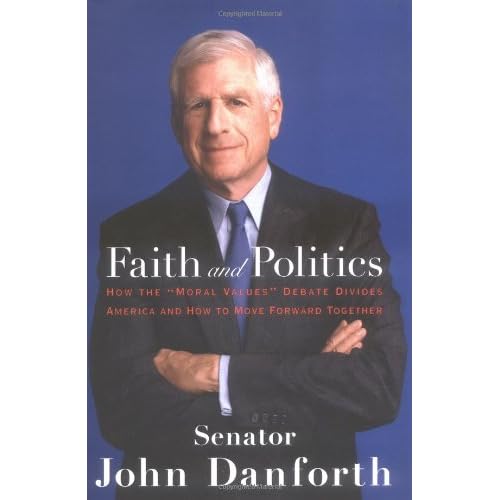
John Danforth's "Faith & Politics"

There's an old saying that there's three things you're not supposed to talk about in public: faith, politics, and sex.

John Danforth, former Republican US Senator of Missouri and an ordained Episcopal priest, dares to tackle two of those topics in his new book, "Faith and Politics."

And the third topic gets mentioned. In an interview with Danforth in the St. Louis Post-Dispatch, Danforth recalls his Yale divinity school dean telling him that studying both religion and law was like "being a striptease saint."

His dean raises an important question: Is religious faith incompatible with politics?

Danforth asserts in his book, "No political agenda can claim to be God's will."

Oh?

Danforth's statement is directed at the Religious Right. But if it's true, it equally applies to the religious left. Try telling the people of the liberal United Church of Christ that, "no political agenda can claim to be God's will." My denomination has never been shy to leave their faith behind in the sanctuary when they go out in the public square--take for example our President and General Minister's John Thomas protest in Washington DC that the proposed 2006 congregational budget was immoral. His presence sprang out of not just a political, but also religious conviction.


Here's the problem with Danforth's claim:

It implies that discernment of God's will is not possible when the issue in question concerns something of interest to government. What are religious people to do? Relegate discernment of God's will to life's smaller matters, like deciding what clothes to wear? Please. God's will is much bigger.

Maybe what Danforth is really getting at is this: If God's will about some political matter is discernable, it shouldn't be expressed or packaged as such. To this end, I'm in the crowd that Danforth speaks of when he says there are some "people who do not believe that the kingdom of God can be reduced to a political platform."

While God's kingdom agenda should never be reduced to a political platform (God's program is much, much bigger), we shouldn't make the opposite mistake and think it excludes any political platform.

It's better to say, "No political agenda can claim with absolute certainty to be God's will." This revised statement retains the assumption that God does indeed have an interest in the decisions made by government--decisions that hopefully make the world a better place. And, it retains the notion that Christians can and should humbly seek God's will in the political arena.

Do Christians do politics well? Of course not. Should we then sweep all mention of God out of politics? Absolutely not.

I suspect what Danforth doesn't like is the views of religious conservatives on issues like abortion and marriage--and also the fact they use the democratic process to win at the polls.

All Christians--liberal and conservative--have a responsibility to seek God's will and, yes, express that conviction by getting involved in the political process.

That's responsible discipleship and good citizenship.


UPDATE: Jim Wallis and Ralph Reed trade barbs on religious liberal and conservative politics at Beliefnet.com

Monday, September 18, 2006

Haircuts

Recently I took my 3-year-old son to the barber for the first time.

He cried the entire 30 minutes he was in the chair.

My wife told this story to her lady friends, saying, "He told me angrily, 'I wanna take it off!'"

One of her friends replied, "After coming home once from the beauty parlor, I said the same thing!"

Friday, September 15, 2006

Pope's Remark Upsets Muslims

Pope Benedict XVI is in big trouble with the Muslim world.

Why?

Because he quotes a guy who puts down Mohammed, the founder of Islam.

Remember the fall out from the European editorial cartoon scandal?

All the hysteria? All the misinformation?

Here we go again.


But his time, the stakes are much higher.


The lecture (see the Vatican link here) was given Tuesday, September 12th at the University of Regensburg in Germany, where the Pope once taught years ago. The subject of the talk was the role reason plays in conceptualizing the Christian God.

But everyone is focusing on this quote:

"Show me just what Mohammed brought that was new, and there you will find things only evil and inhuman, such as his command to spread by the sword the faith he preached."

This remark was first made in 1391 by Byzantine emperor Manuel II Paleologus, as he was debating a Persian on the subject of Christianity and Islam, and the truth of both.

Susan Frazer in an AP report writes: "Benedict did not explicitly agree with the statement nor repudiate it."

I'm not an expert on the history of Mohammed, so if you know, please tell me:

Did Mohammed command his followers to use the sword to spread Islam? Yes or no?

If Mohammed did not advocate the sword, then I can sympathize with Muslims' anger. I don't like my religious figure--Jesus Christ--being grossly misrepresented either.

But if Mohammed did, then why are Muslims so upset? It's history. And sometimes, history hurts. Christians certainly have plenty in theirs to be embarrassed about.

No matter the answer to the above question, isn't it obvious that a few well publicized Muslims are using the sword today in the name of Allah--and in turn labeling Islam as violent? Are such deeds evil and inhuman?

Nobody however is focusing on these essential questions. Instead, all the attention is focused on condemning the Pope.

Here's one example from Frazer's report:

Salih Kapusuz, a deputy leader of Turkish Prime Minister Recep Tayyip Erdogan's party, said Benedict's remarks were either "the result of pitiful ignorance" about Islam and its prophet, or a deliberate distortion.

"He has a dark mentality that comes from the darkness of the Middle Ages. He is a poor thing that has not benefited from the spirit of reform in the Christian world," Kapusuz was quoted as saying by the state-owned Anatolia news agency. "It looks like an effort to revive the mentality of the Crusades."

"Benedict, the author of such unfortunate and insolent remarks, is going down in history for his words," he said. "He is going down in history in the same category as leaders such as (Adolf) Hitler and (Benito) Mussolini."

Revive the mentality of the crusades?

In the same category as leaders such as Hitler and Mussolini?

Mr. Kapusuz, read the Pope's lecture. He clearly condemns religious violence. He clearly condemns forced religious conversions. Do you?

After the now infamous quote, the Pope continues to cites the Emperor:

"The emperor, after having expressed himself so forcefully, goes on to explain in detail the reasons why spreading the faith through violence is something unreasonable. Violence is incompatible with the nature of God and the nature of the soul. 'God', he says, 'is not pleased by blood - and not acting reasonably is contrary to God's nature. Faith is born of the soul, not the body. Whoever would lead someone to faith needs the ability to speak well and to reason properly, without violence and threats... To convince a reasonable soul, one does not need a strong arm, or weapons of any kind, or any other means of threatening a person with death...'".

And then the Pope says this. Here is what he believes:

"The decisive statement in this argument against violent conversion is this: not to act in accordance with reason is contrary to God's nature. "

The Pope's lecture is very philosophical.

The reaction to it is not.


UPDATE: Ted Olsen at Christianity Today provides a load of links to this story.
UPDATE 2: The Anchoress provides commentary and lots of good links.
UPDATE 3: OpinionJournal.com has an excellent editorial that summarizes the Pope's original address and the "reasonable" invitation to dialogue he makes to Muslims.
UPDATE 4: Columinist Kathleen Parker summarizes well the Pope's point.

Thursday, September 14, 2006

Grieving Sunflowers

Posted by Picasa

In memory of Mike Raleigh
1956-2006


Picture taken at sunset, south of Little River, on Highway 46.

Wednesday, September 13, 2006

Football and Idolatry

In the previous post I talked about football and idolatry.

I got my own story.

For weeks I've been anticipating the start of the NFL season. My beloved Bengals are looking to have a pretty good year. Even better, their first game was going to be on TV in central Kansas (a rarity). They were playing the Chiefs.

Remember the old ketchup commercial jingle? "Anticipation." That was me.

Bengals on TV. Bengals on TV. Bengals on TV.

I thought it all week.

Meanwhile, on the church schedule was a baptism service Sunday afternoon. My two daughters and four other people were scheduled to go under at Olander's Pond.

I scheduled the service for 5:30pm because...well...that would be long after the Bengals game was over. I could watch every play of the game and soak in the post-game show on TV and on the NFL "Field Pass," where I subscribe to listen to the Bengal's radio announcers.

On Wednesday before the big game, our family got word that my wife's sister and her son would be coming in from Missouri to visit for the weekend.

My wife asked, "My sister has to leave early Sunday afternoon to go back home. Why don't you schedule the baptism service earlier--like at 2:00pm-- so they can see it?"

I replied, "No. That won't work."

She came back, "Why not?"

"Because the Bengals are on TV," I said. "It's the season opener. I'm watching the game."

It was perfect reasoning.

"Honey," she began. "This is our kids' baptism. Our family needs to see it."

"They can see it," I reminded her. "They can stay in town till 5:30pm and leave afterwards."

"But then they won't get back home till after midnight," charged my wife. "That's not considerate. Make it for 2:00pm."

"No," I said, now getting angry. "I'm watching the game. It's the first game of the year. And on top of that, I can't see the Bengals on TV every week. This is my one chance."

Then my wife--as only wives can do--laid down the hammer: "So that game is more important than your family seeing your children's baptism. Glad to know you got your priorities in the right place."

She walked out of the room.

Darn wife.

Darn Holy Spirit.

I rescheduled the baptism.

It was at 3:00pm.

Tuesday, September 12, 2006

Commentary on Nike's "Football is Everything" Commercial


Last Thursday night kicked off a new season of NFL football and also a new round of commercials that merchants hope will catch your eye.

One that caught mine was Nike's "Football is Everything."

The setting is Briscoe High School and what typically happens across high schools in America on Friday. Football players wear their jerseys to school, daydream about the game in class, and then go out and play the big game in front of the home crowd.

The commercial features "Ryan," an ordinary high school student. But Ryan's teammates are hardly ordinary--they're a whole bunch of NFL players, like the Atlanta Falcon's QB Michael Vick and the Chicago Bear's LB Brian Urlacher. On the last play of the game, with Briscoe down 4, the San Diego Charger's LaDainian Tomlinson tosses a halfback pass to Ryan in the end zone. Ryan catches it and the Briscoe Hawks pull out a big 16-14 win.

I really like the commercial. It's fun and very clever. Through Ryan, all of us regular folk get to be the hero among NFL superstars. How often does that happen? It's every athlete's fantasy.

The musical soundtrack for the commercial is Norman Greenbaum's catchy 1970's hit, "Spirit in the Sky." Having worked in a music retail store for many years, I recognized the song immediately.

The musical intro plays in the background of the commercial's opening scenes. Then after Briscoe's football head coach, (played by NFL Hall of Famer Don Shula) says in the locker room after his pregame pep speech, "Take a knee," you start hearing the first verse of the song through the rest of the commercial:

When I die and they lay me to rest
Gonna go to the place that's the best
When I lay me down to die
Goin' up to the spirit in the sky
That's where I'm gonna go when I die
When I die and they lay me to rest
Gonna go to the place that's the best

The Nike spot ends with a still shot of the triumphant Briscoe team and the words, "Football is Everything."

And that's when I did a spiritual, theological double take.

I love this commercial. So why does it bother me? It's that song.

The lyrics of "Spirit In the Sky" talks about going to heaven after you die. As Greenbaum says, "Goin' up to the Spirit in the sky." Going to heaven because of knowing a "friend" named Jesus.

The song talks about what is ultimate in life:

What transforms life from the ordinary to extraordinary.
What takes life to a higher plane.
What gives purpose and meaning to life.

Jesus.

Forgive me. I'm a pastor. Jesus is my life. I try to look at all of life through God's perspective.

But when I heard Greenbaum's song, I immediately thought, "Oh my gosh, that's idolatry."

Idolatry isn't a very worrisome word on the surface. But that word is like cancer. Idolatry is a spiritual disease that lures you away from Jesus--your Maker and Savior. It tempts you to move your worship and devotion from what's most important to something less important. To switch your allegiances--from God to something less than God.

Like football.

I love football. But it's not everything.

Monday, September 11, 2006

Peggy Noonan on the Sounds of 9-11

Today is the 5th anniversary of 9-11.

Peggy Noonan has an outstanding article posted at Opinion Journal. She reviews 9-11 in a slightly different way that is sorrowful, yet rewarding:

Everyone remembers the pictures, but I think more and more about the sounds. I always ask people what they heard that day in New York. We've all seen the film and videotape, but the sound equipment of television crews didn't always catch what people have described as the deep metallic roar...

I think too about the sounds that came from within the buildings and within the planes--the phone calls and messages left on answering machines, all the last things said to whoever was home and picked up the phone. They awe me, those messages.

Something terrible had happened. Life was reduced to its essentials. Time was short. People said what counted, what mattered. It has been noted that there is no record of anyone calling to say, "I never liked you," or, "You hurt my feelings." No one negotiated past grievances or said, "Vote for Smith." Amazingly --or not--there is no record of anyone damning the terrorists or saying "I hate them."

No one said anything unneeded, extraneous or small. Crisis is a great editor. When you read the transcripts that have been released over the years it's all so clear...

This is what I get from the last messages. People are often stronger than they know, bigger, more gallant than they'd guess. And this: We're all lucky to be here today and able to say what deserves saying, and if you say it a lot, it won't make it common and so unheard, but known and absorbed.

I think the sound of the last messages, of what was said, will live as long in human history, and contain within it as much of human history, as any old metallic roar.

Friday, September 08, 2006

Military Mistakenly Drops Practice Bombs on Lake

This is a Kansas story I missed over the summer, but just recently heard:

Up at Kanopolis Lake, 20 minutes from where I live in Little River, a B-52 Air Force plane originating out of Louisiana dropped not one, but nine concrete practice bombs into the lake on July 19th, to the astonishment of stunned witnesses lounging on the beach.

Opps. I mean, really big opps.

The story from the Wichita Eagle is here and coverage by a military site, with some humorous comments is here.

The "bombs" were supposed to be dropped at the nearby Smoky Hill National Guard Ranger, which is about 15 miles northwest of the lake. It shouldn't have been difficult to find. It has a 12,000-acre target area.

Officials at the lake have yet to find the bombs. It's not yet clear what damage was done to the lake bottom or the wall of the reservoir damn.

It's hard to tell if the folks in the plane dropped the bombs by accident or as a joke. It probably doesn't matter. Either way, they're in a whole heap of trouble.

The Bible word "sin" means, "to miss the mark." In Romans 3:23, it's utilized to show how utterly off-target humanity is in pleasing God.

Whether intentionally or unintentionally, none of us "made in the image of God" creatures measures up before our maker in thought, word, or deed. We've missed the target God sets before us. We need grace.

Just like that B-52 crew.

This incident happened in July. It's now September.

Wonder if they're out of the doghouse yet?

Thursday, September 07, 2006

Andy Stanley's "Communicating for a Change" Part 2 of 2

In the last post I reviewed Andy Stanley's take on effective preaching in his new book, "Communicating for a Change." What I like best is his audience-focused, Me-We-God-You-We outline that clears the way for genuine communication with an audience.

After plowing through the book, I tried his suggested one point message outline this past weekend in a message titled, "Your Work Matters To God." Here goes:

ME--Orientation to the message topic, or what information does the congregation need to know?

During high school and college, I once had a job I loved, but then had to take a boring job I didn't like.

WE--Identification with audience, or what's the motivation for the listeners knowing this?

All of us have struggles with our jobs (Here I addressed the problems faced by high school students, self-employed farmers, construction workers, and retirees)

transition: God cares about our work because His Word tackles one of the most difficult work situations you could imagine--slavery

GOD--Illumination, or looking at what the Bible says on the topic

Exposition of Colossians 3:22-4:1. Brief elaboration of slavery in Roman culture and role Scripture plays in eventually ending slavery in our age. Observation from text: While workers struggle with animosity toward their bosses, laziness, and proper motivation, God calls believers to serve Him while working.

Summary point: How you serve at your job is a reflection of the God you serve.

YOU--Application, or what the listener needs to do with God's Word

Make your work an act of worship (Here is the one point of the one point message)

WE--Inspiration, or why the listener needs to apply God's Word

What would it look like if every person in this room went out and worshipped God while they worked. How might your attitude be different? How might your interaction with others be different?

(This is the one part of Stanley's outline where I really learned something new. This is a time for vision casting--what the application would look like if everyone in the church did it)

In closing, I reviewed the life of Willy Lohman, an aging, desperate, "has been" salesmen from Arthur Miller's play, "Death of a Salesman." Point: Worshipping God at work doesn't automatically take away your problems, but it gives you the opportunity to see God work through your problems.

So I preached the message, recorded it, and listened to it earlier this week. And?

I have a ways to go!

Wednesday, September 06, 2006

Andy Stanley's "Communicating for a Change" Part 1 of 2

While full service retail Christian book stores are getting rarer by the day, central Kansas is fortunate to have one of the best in probably a three state region--Body & Soul in McPherson, Kansas.

Last week when I was there I bought "Communicating for a Change," by Andy Stanley, son of the famous Atlanta preacher Charles Stanley, and pastor of North Point Church in suburban Atlanta. While Andy is Charles' son, he's definitely his own person--especially when it comes to preaching. He's completely different than his Dad.

Andy's method goes against the grain of many evangelical preachers who preach three or four point messages. Stanley contends that while this kind of preaching is useful in relaying biblical information, it's ineffective in transforming lives. (And isn't that the goal of preaching?) Instead, Stanley lays out a compelling case for preaching one point messages.

The first section of the book is an extended parable of a frustrated Pastor Ray who is surprised to learn from a truck driver the principals of life changing communication. From a book description at Amazon:

"Pastor Ray...discovers that the secrets to successful speaking are parallel to the lessons a trucker learns on the road. By knowing your destination before you leave (identifying the one basic premise of your message), using your blinkers (making transitions obvious), and implementing five other practical points, you'll drive your message home every time!"

The genius of the book is Stanley's method of outlining sermons. Instead of the traditional outlining of "I. A. 1. 2." that is text-centered and text-focused with an infinite amount of principals/applications, Stanley offers up a "Me, We, God, You, We" model that is text-centered and audience-focused and has only one principal for application. Some free examples of Stanley's preaching are available here.

"Preaching for a Change" resonated with me for two reasons. First, one of the greatest responsibilities of a preacher is to show WHY an audience should give a hoot and listen. Please pastor, answer the question, "Why MUST I hear this? What is my NEED?" Far too often, I've heard messages where the preacher recognizes my existence with a silly joke, but then jumps into the text assuming that I'm interested in his topic. (I guess showing up in church was good enough?) Stanley's model makes the speaker develop the need--the tension or the problem the listener needs resolved. In other words, the preacher's "burden" that compels him to proclaim God's message (it has to be more than "It's Sunday, I have to say something.")

Second, this book struck a cord with me because I'm convinced that the pastor's primary purpose when opening the Bible on Sunday morning is more preaching than it is teaching. Teaching aims at the head. But preaching goes for the heart--its aim is to persuade. Most people know intellectually what they should do. What they need is the Holy Spirit's burden to act on it.

In my next post I'll demonstrate Stanley's model. I tried it this past Sunday in my Labor Day weekend message on work.

Tuesday, September 05, 2006

Big Brutus


With Labor Day over, summer has essentially come to an end. It's an opportune time to look back at what we did for vacation.

This year, the Weis family stayed in Kansas. In July, my Dad and I enjoyed the US Senior Golf Open in Hutchinson. In August, my family visited friends in Pittsburg, KS. On the way home, we stopped to see Big Brutus, the second largest electric shovel in the world.

Brutus is 16 stories tall and weighs 11 million pounds. Located in southeast Kansas, Brutus was the symbol of the Kansas coal strip mining industry in the 1960's and 70's. What's fun about Brutus is that you can climb through him--up through the second story (the orange painted section).

Then on Sunday evening-Monday afternoon, the family went camping for the first time. That had all the makings for a big disaster, but we made it easy on ourselves by driving only 20 minutes to Kanopolis Lake. One part is run by the state; the other side is operated the Feds.

Can't say that sleeping on the floor of the van was my idea of restful sleep, but we had fun swimming, grilling, and watching a gorgeous Kansas sunset. With the first attempt a success, I dare say we might try camping again next summer.

What did you do this summer? I hope you were able to carve out some time for refreshment.

Monday, September 04, 2006

Labor Day

Labor Day: The day where we celebrate work by taking a day off from work.

Friday, September 01, 2006

How To Stop a Sneeze

It's Friday, so here's something off the beaten path...

This is how you stop a sneeze. Really. It works.

When you feel a sneeze coming on, and can't afford to do it...because you're talking to your boss or looking intently at your wife...this is what you do to hold it.

Take your finger and put it under the bottom of your nose, between your nostrils. Slowly push up.

That's it. Try it.

Now, if holding my tongue was this easy.